
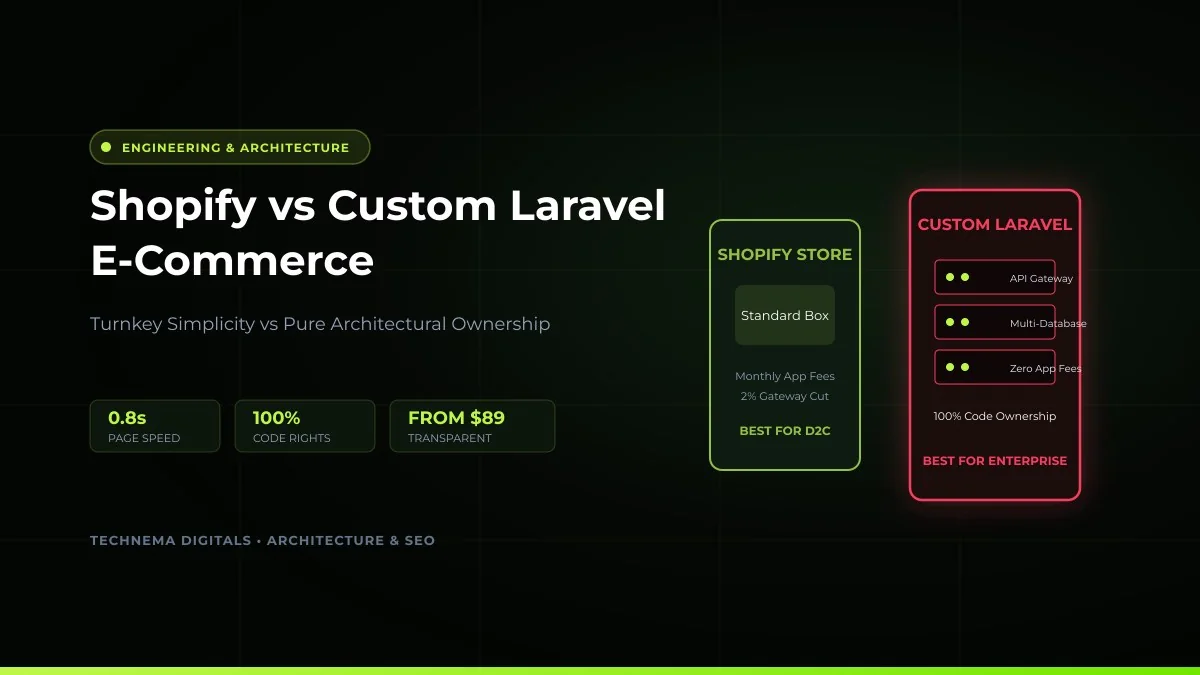
The $500,000 Revenue Crossroads: Platform Rent vs Infrastructure Ownership
Every growing merchant reaches a critical inflection point. In the early days, choosing an off-the-shelf software-as-a-service solution like Shopify is often an obvious, low-friction decision. You get an immediate hosted storefront, built-in payment rails, and an extensive ecosystem of modular plugins.
However, once your digital storefront begins processing between $30,000 and $250,000 per month, the financial mathematics change dramatically. Between base platform tiers, third-party monthly application fees, and merchant processing surcharges on external payment gateways, stores often surrender $15,000 to $50,000 each year purely in recurring operational overhead.
This comprehensive guide compares Shopify with custom architectures built on Laravel. We examine real-world operational costs, page load speed impacts, checkout customization flexibility, and long-term business equity so you can make the right engineering decision for 2026 and beyond.
1. The Hidden Platform Tax: App Subscription Creep
When founders calculate the cost of Shopify, they typically look at the base tier ($39/mo or $105/mo). However, an out-of-the-box Shopify theme lacks fundamental conversion features required by modern consumers. To operate competitively, merchants install plugins for:
- Advanced product filtering and live search ($29 to $99/mo)
- Customer review aggregators and video testimonials ($49 to $199/mo)
- Upsell and post-purchase one-click cross-sells ($39 to $149/mo)
- Custom product bundles and dynamic volume discounting ($29 to $89/mo)
- Inventory sync and multi-warehouse routing ($79 to $250/mo)
Within six months, your store is running 12 to 18 independent JavaScript extensions. Each plugin injects external scripts into your document object model, increasing total page weight, degrading Google Core Web Vitals, and inflating your monthly credit card charges by $400 to $1,200.
With a custom Laravel application, these capabilities are engineered directly into the application framework using clean PHP, Alpine.js, and optimized database queries. There are zero third-party software subscriptions, zero external script injections, and zero ongoing vendor licensing fees.
2. Performance & Conversion Rates: Microseconds Equal Dollars
Google and Amazon consumer research consistently proves that every 100 milliseconds of page latency reduces conversion rates by approximately 7%. Standard Shopify stores burdened with multi-app ecosystems frequently score under 45 on Google PageSpeed Insights for mobile devices, suffering Largest Contentful Paint times exceeding 3.8 seconds.
Because you cannot modify server-level caching headers, tune Nginx configurations, or control database query execution plans on Shopify, your optimization capabilities are artificially restricted to compressing image assets and deferring theme scripts.
Conversely, a custom Laravel e-commerce storefront deployed on optimized cloud infrastructure (such as AWS, DigitalOcean, or Hetzner) leverages Redis in-memory object caching, OPcache PHP pre-compilation, and database indexing. As demonstrated in high-performance engineering projects like PowerCompress.com (a browser-based image compression, file format converter, and background removal tool website), custom architectures regularly deliver sub-500ms client-side processing speeds and eliminate script bloat entirely.
3. When Shopify Is Undoubtedly the Right Choice
Despite its long-term cost drawbacks at scale, Shopify remains an exceptional choice for specific business phases:
Rapid Validation
When testing a brand new consumer product with less than $5,000 in startup capital, Shopify allows you to launch within days with minimal engineering investment.
Standard Direct-to-Consumer
Apparel, single-SKU consumer goods, and simple retail businesses that do not require custom manufacturing rules or complex corporate invoicing workflows.
At Technema, we build turnkey, beautifully designed Shopify stores starting at just $299 for brands seeking quick market entry without bloated agency build fees.
4. When Custom Laravel Becomes Imperative
You should plan your migration to a custom Laravel architecture when your operations meet any of the following parameters:
- B2B Wholesale & Dealer Portals: You have different client tiers requiring contract-specific pricing, minimum order quantities, and net-30 credit terms.
- High Annual GMV: Your store generates over $40,000 per month. At this volume, eliminating third-party app subscriptions and platform percentage cuts saves tens of thousands annually, covering your custom engineering costs within months.
- Custom Calculators & Configuration: You sell customizable products (such as dimensional building supplies, tailored machinery, or subscription toolboxes) that Shopify variant models cannot natively calculate.
- Direct API Ecosystems: You need real-time synchronization with proprietary warehouse robots, internal ERPs (SAP, NetSuite), or legacy accounting databases without middleware subscription tollbooths.
The Technema Hybrid Recommendation
If your business is generating under $250,000 annually, stay lean on Shopify or WooCommerce. Keep your app count strictly under 6. The moment your subscription costs cross $500 monthly or your transaction fees pinch margin, engage our engineers to build your custom Laravel storefront. Check out our transparent e-commerce pricing packages for full scope details.
Frequently Asked Questions

Written by Anas Awan
Founder & CEO of Technema Digitals
Anas is the Founder & CEO of Technema Digitals, engineering high-speed web architecture, local Google Maps domination, and conversion-optimized systems that turn search impressions into paying clients for US and Canadian businesses.