
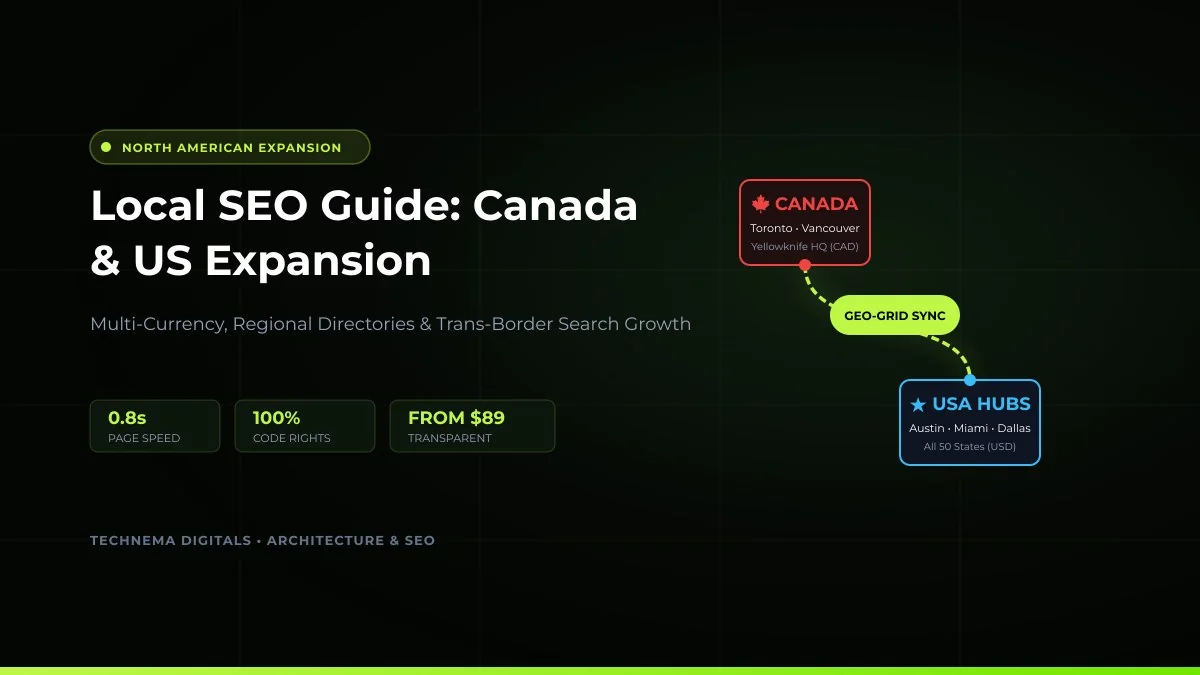
The Bilateral Growth Engine: Why Cross-Border Search Matters in 2026
The economic relationship between the United States and Canada represents the largest two-way trade partnership on the planet. For expanding companies, whether you are a specialized commercial contractor in Calgary looking into Washington state, or an enterprise software agency in Seattle expanding into Vancouver and Toronto, cross-border clients offer immense contract value.
However, executing local search marketing across national boundaries requires distinct technical discipline. Google operates separate algorithmic evaluation parameters for google.com and google.ca. Attempting to rank in multiple cities by simply duplicating a single webpage and swapping city names will immediately trigger Google's Doorway Page algorithm penalties, destroying your organic visibility across both nations.
In this masterclass, we share the architectural playbook used by Technema Digitals to engineer high-ranking regional hubs across 16 major metropolitan centers spanning Texas to the Northwest Territories.
1. The 4 Fatal Pitfalls of Multi-City Expansion
Avoid these costly mistakes when structuring multi-city service pages:
Thin Doorway Pages
Copying 1,000 words of identical text and solely replacing "Miami" with "Denver." Google Helpful Content systems classify this as programmatic spam and de-indexes the entire cluster.
Fake Virtual Office Leases
Renting a Regus mailbox in a Canadian city without physical personnel to force a Google Maps listing. Google utilizes automated street view verification and video re-verification, resulting in permanent suspensions.
Mismatched Currency & Phone Data
Displaying single-currency pricing or US-only toll-free numbers on Canadian landing pages undermines user trust and causes immediate bounces.
Splitting Domain Authority
Launching a separate brand-new .ca domain from scratch, dividing your marketing budget and forcing your team to earn backlinks for two separate sites simultaneously.
2. The High-Authority Hub Architecture
Rather than maintaining disparate websites, the most effective cross-border architecture organizes regional markets under a structured directory on your primary authority domain:
https://technemadigitals.com/locations/{city-state-or-province}
Every location page must be treated as a comprehensive mini-homepage engineered with genuine regional authenticity:
- Specific Regional Context: Reference local commercial districts, municipal industry drivers, and unique regional business needs (for example, cold-weather technical specifications for our Yellowknife Hub or fast-paced tech startup delivery for our Austin Hub).
- Localized JSON-LD Schema: Implement
LocalBusinessstructured data with exact geographical latitude and longitude coordinates, municipal postal codes, and regional service boundaries. - Verified Regional Portfolio Pieces: Showcase case studies and real project deliveries from the surrounding market.
- Central Directory Interlinking: Link all city pages into a structured Locations Master Directory with clear breadcrumbs and crawlable navigation.
3. Google Business Profile Strategy for Cross-Border Teams
If your business maintains a genuine physical branch office or licensed local staff in both countries, establish distinct Google Business Profiles for each location. Ensure that:
- The website link on the US profile points directly to your corresponding US city landing page (e.g.,
/locations/seattle-wa), not the root homepage. - The website link on your Canadian profile points directly to the Canadian hub (e.g.,
/locations/vancouver-bc). - Local citations in Canada (YellowPages.ca, 411.ca, Canadian Trade Index) point to the Canadian location URL with accurate CAD pricing indicators.
- Customer reviews mention local neighborhoods and city landmarks, sending natural entity signals into Google's localized knowledge graph.
How Technema Powers Regional Growth
We build high-performance web systems and multi-location search engines for brands targeting North American expansion. From turnkey business websites at $89/mo to dedicated Local SEO retainers, we engineer search equity that lasts. Explore our transparent pricing plans today.
Frequently Asked Questions
en-US and en-CA) helps Google serve the correct national currency page. However, for distinct city hubs (e.g. Toronto vs Miami), standard internal linking and geo-targeted schema are typically sufficient.

Written by Anas Awan
Founder & CEO of Technema Digitals
Anas is the Founder & CEO of Technema Digitals, engineering high-speed web architecture, local Google Maps domination, and conversion-optimized systems that turn search impressions into paying clients for US and Canadian businesses.