
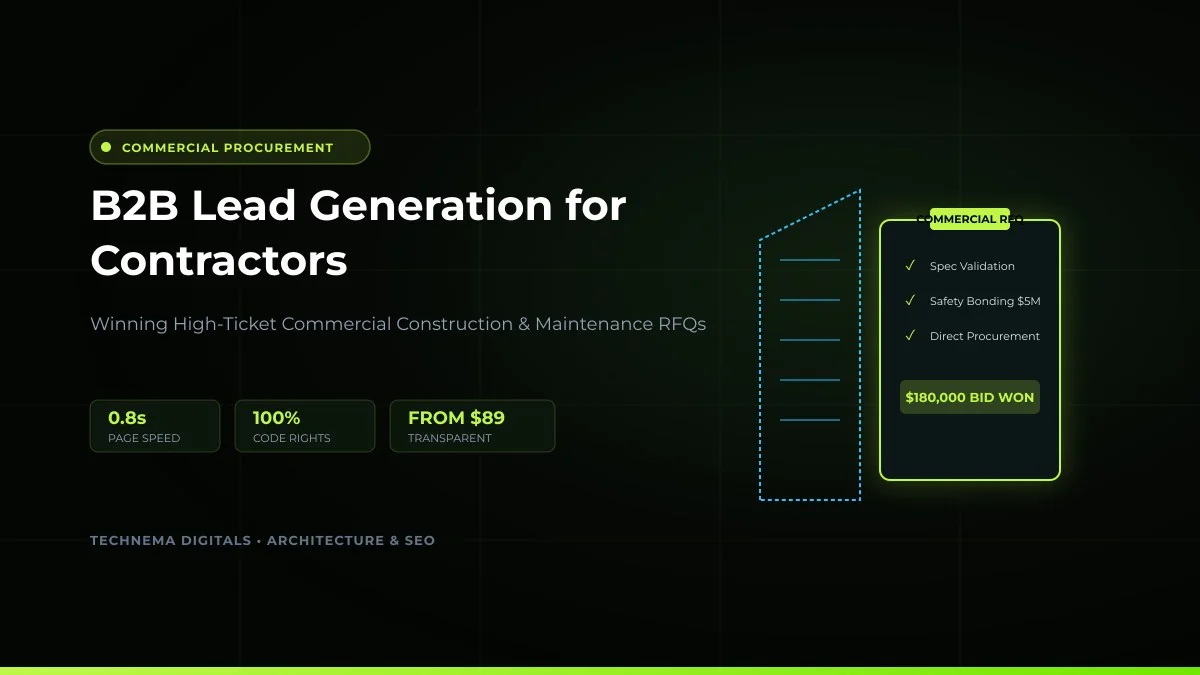
The Generational Shift in Commercial Procurement
For decades, commercial construction contracts were won almost exclusively on golf courses, over steak dinners, and through legacy handshake networks. If you were an electrical subcontractor, mechanical contractor, or commercial framer, you waited for personal phone calls from general contractors you had worked with for fifteen years.
In 2026, the construction leadership landscape has fundamentally shifted. A new generation of tech-literate project managers, estimators, and real estate asset developers are responsible for sub-tier procurement. When entering new regional markets or facing tight delivery timelines, their first reflex is not an old rolodex, it is a Google search and a rigorous digital background review.
If your web presence consists of a broken, outdated page created in 2014 with no safety ratings, no portfolio filter, and no blueprint upload interface, your company is quietly excluded from commercial bid lists before you even know a project was awarded. Here is how modern commercial trade contractors build an unbeatable B2B digital acquisition engine.
1. The 5 Must-Have Pillars of a Commercial Subcontractor Web Engine
Commercial general contractors do not look for flashy animations. They look for risk mitigation, financial stability, and operational speed:
Safety & EMR Credentials
Prominently feature your Experience Modification Rate (EMR < 0.85), Total Recordable Incident Rate (TRIR), OSHA certifications, and ISNetworld verification. Commercial risk managers review this first.
Bonding & Project Capacity
State your single-project and aggregate bonding limits ($2M, $10M, $25M+). GCs need immediate certainty that you have the balance sheet to complete heavy commercial schedules.
Segmented Portfolio Filtering
Allow estimators to filter past completed projects by sector: Healthcare, Cold Storage, Industrial Warehousing, Multi-Family, and Education with square footage metrics.
Digital Planroom & RFP Intake
Deploy a dedicated portal interface where GCs can drag and drop 200MB architectural drawings, specifications, and addenda directly to your estimating team.
2. Real Case Proof: B&B Builders 89 LLC
Consider our enterprise case study with B&B Builders 89 LLC. Prior to partnering with Technema, their web presence was a generic one-page brochure that yielded zero commercial inquiries over a three-year span.
Technema redesigned their digital infrastructure from the ground up, engineering a high-speed corporate platform with dedicated sub-sector landing pages, bonding credential showcases, and a secure blueprint intake portal. Within 180 days of launch:
- Ranked #1 for 14 commercial sub-trade and structural framing keywords in their regional metropolitan radius.
- Received 19 direct RFP invitations from regional general contractors entering their territory.
- Closed 3 commercial multi-family development contracts representing over $1.4 million in gross contract value.
3. Hyper-Targeted B2B SEO: Capturing High-Intent Search Intent
Consumer SEO focuses on generic keywords like "contractor near me." In commercial construction, B2B buyers search with precise engineering terminology. Your organic search architecture must capture targeted queries such as:
- "Commercial MEP contractor Dallas TX"
- "Tilt-up concrete subcontractor Denver industrial"
- "Heavy civil site utility contractor Charlotte NC"
- "Structural steel erector certified AWS Toronto"
These high-intent search phrases may only have 40 to 90 searches per month, but every single searcher controls a multi-hundred-thousand-dollar commercial subcontract. By building dedicated service-area pages optimized for these exact specifications, your firm captures the most profitable projects before competitors even submit bids.
Streamline Estimating with AI Automation
Combine your custom web portal with our AI business automation pipelines to automatically log inbound bid invitations, notify estimators via instant alerts, and generate branded prequalification packets in minutes.
Frequently Asked Questions

Written by Anas Awan
Founder & CEO of Technema Digitals
Anas is the Founder & CEO of Technema Digitals, engineering high-speed web architecture, local Google Maps domination, and conversion-optimized systems that turn search impressions into paying clients for US and Canadian businesses.