
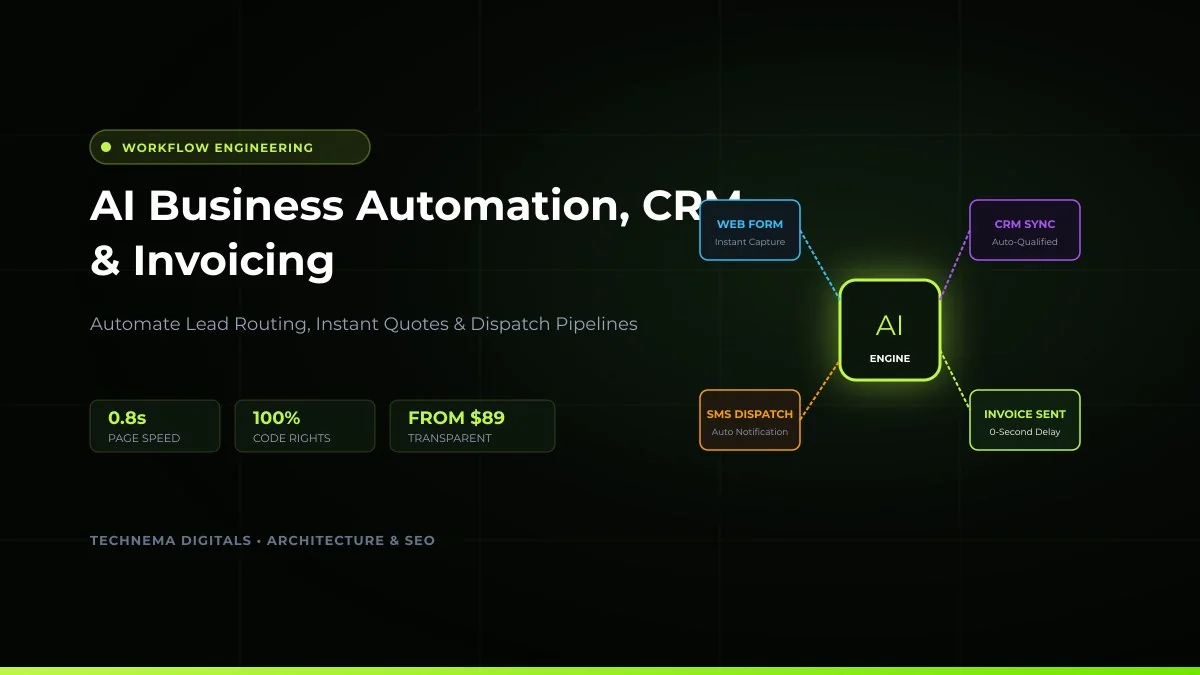
The Invisible Operational Leak: Death by 1,000 Copy-Pastes
If you operate a service company, consultancy, or growing trade firm, review how your staff spent the last work week. A client submits a website inquiry. An office manager manually copies their name, email, and phone number from an email notification into an Excel spreadsheet or CRM.
They open Google Calendar to draft an appointment invite. After a service call, they log into QuickBooks or Stripe to manually type out an invoice. If the invoice goes unpaid after seven days, they compose another follow-up email. When a new contract is signed, someone manually creates a folder in Google Drive and sends a PDF onboarding questionnaire.
In modern enterprise operations, this is not just inefficient, it is financial self-harm. In 2026, high-performing small businesses automate these repetitive workflows entirely, saving 15 to 25 hours of salaried administrative labor every single week. Here is how custom AI automation and event-driven webhooks transform everyday operations.
1. The Financial Mathematics of Automation
Let us examine the tangible return on investment from automating standard administrative processes:
Beyond direct payroll savings, automated operations eliminate human transcription errors, missed customer follow-ups, and delayed invoicing, accelerating cash flow velocity across your entire enterprise.
2. The 3 Core Automated Workflows Every Business Needs
You do not need an enterprise IT department to deploy high-leverage business automation. Start with these three high-impact pipelines:
Workflow 1: Instant AI Lead Triage (<60-Second Response)
When a prospect submits your contact form, an automated pipeline parses their project budget and urgency using natural language classification. Qualified leads instantly receive a personalized SMS confirmation and calendar booking link, while your on-duty estimator gets a push alert with full context.
Impact: Multiplies sales closing rates by up to 391% over traditional 4-hour email replies.Workflow 2: Zero-Touch Billing & Payment Reconciliation
When a project milestone is marked complete in your project portal, an encrypted Stripe webhook generates the branded invoice and dispatches it via email and SMS. Upon payment confirmation, the accounting ledger is reconciled, your client receives a tax receipt, and the subsequent project phase is automatically unlocked.
Impact: Eliminates accounts receivable chasing and shaves days off payment turnaround.Workflow 3: Automated Client Onboarding
The moment a retainer is deposited, the system generates secure login credentials to your custom client portal, provisions cloud storage folders, issues the kickoff questionnaire, and schedules the initial strategy session without manual intervention.
Impact: Creates a seamless corporate first impression and eliminates onboarding delays.3. Why Custom Code Outperforms Fragile No-Code Middleware
Many small businesses begin automating with tools like Zapier or Make. While helpful for basic prototypes, relying on multi-tier no-code tools at scale introduces significant technical friction:
- Escalating Monthly Subscriptions: A business processing thousands of events monthly quickly incurs $150 to $500 monthly platform bills.
- Rate Limits & Polling Latency: Standard tiers only poll every 5 to 15 minutes, destroying the real-time speed advantage needed for phone lead intake.
- Fragile Failure Points: If a third-party token expires or a step fails, the entire sync breaks silently without comprehensive logging.
At Technema, we engineer AI business automation and API integrations natively in Laravel and Node.js. Events execute in milliseconds, error logs are centrally tracked, and you pay zero recurring per-task software taxes.
Ready to Modernize Your Operations?
Explore how our team pairs lightning-fast business websites with custom backend automations. Check out our straightforward pricing plans with transparent deliverables and zero lock-in.
Frequently Asked Questions

Written by Anas Awan
Founder & CEO of Technema Digitals
Anas is the Founder & CEO of Technema Digitals, engineering high-speed web architecture, local Google Maps domination, and conversion-optimized systems that turn search impressions into paying clients for US and Canadian businesses.